This project began with a fascination for the aesthetics of military technology: the uncomfortable point at which an object designed to kill can also become beautiful, seductive, even desirable.
At its centre are 1:72 scale military models. I began making models as a child, after Saturday morning pictures, buying kits from the local model shop. Returning to them many years later, I became interested in what these apparently innocent objects actually represent. A Stuka dive-bomber, a tank, a machine-gun emplacement: these are sold as toys, assembled carefully, painted accurately and admired for their detail. At what point does the pleasure of the miniature become uncomfortable? What would it mean, for example, to produce a 1:72 scale model of Auschwitz?
Building the models has consequently become a strangely contemplative activity. There is something almost monastic in the concentration involved: assembling, painting, researching markings and attending to minute details. But the object being contemplated is an instrument of violence. The reduction of something capable of killing people into something small enough for a child to hold in their hand produces a peculiar moral and aesthetic dislocation.
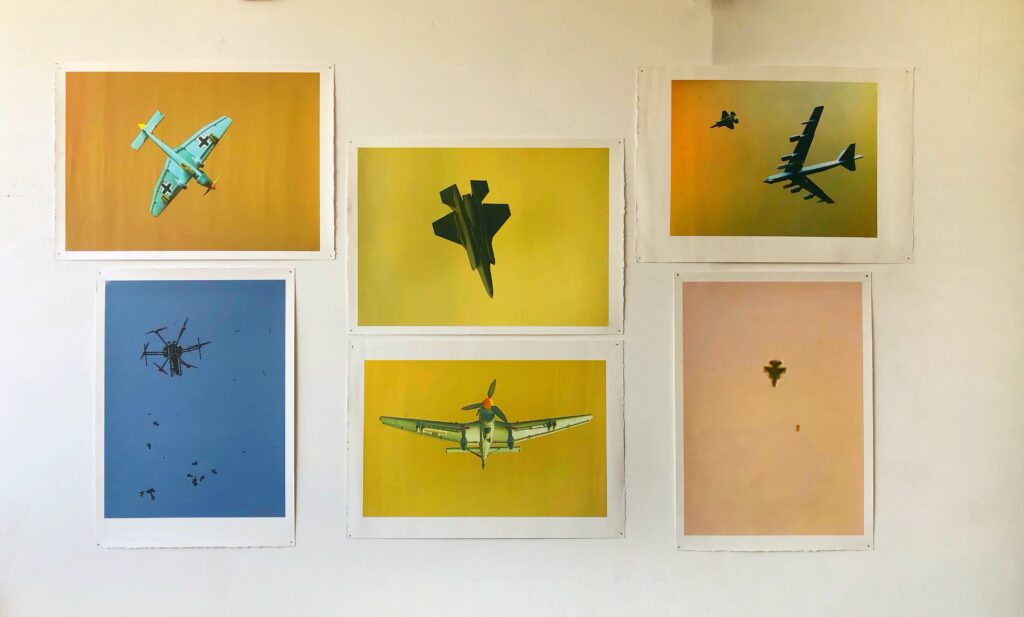
The finished models are suspended in the studio and photographed. Colour, scale and context are manipulated until the resulting images hover somewhere between model photography, landscape, abstraction and historical image. They are deliberately attractive. Sometimes they are beautiful.
There is something here of the sublime: attraction held uncomfortably close to terror. But unlike the overwhelming natural forces that preoccupied Kant, these objects belong to a manufactured sublime. Their terror has been designed, engineered, tested and produced.
In this sense the work operates as a quiet counterpoint to the spectacular horror of Jake and Dinos Chapman’s Hell. There the horror is immediate, accumulative and impossible to overlook. Here it is withheld. A beautifully made little aircraft hangs against an extraordinary sky. It might initially appear nostalgic, playful or simply pleasing to look at. The violence arrives through recognition.
The Ju-87 Stuka makes this contradiction particularly explicit. Its Jericho Trumpet turned the aircraft’s dive into an instrument of psychological terror. The scream became part of the weapon’s cultural identity, surviving long after the aircraft itself as a cinematic shorthand for something falling catastrophically from the sky.
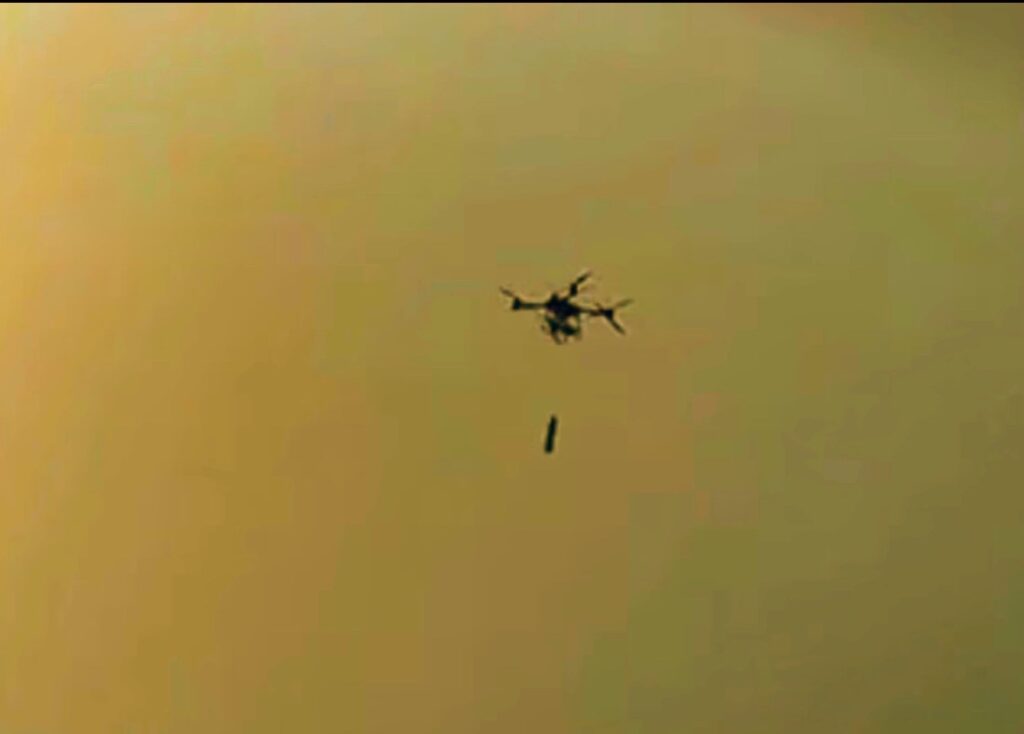
The contemporary drone produces a different relationship between technology, sound and fear. The movement from the Jericho Trumpet to the drone is not a simple history from noise to silence. The scream of the Stuka was concentrated and spectacular; testimony from contemporary conflict describes the persistent sound of drones overhead as something quite different: repetitive, ubiquitous, difficult to escape. Terror moves from the announcement of an approaching weapon towards the possibility of a weapon that remains present.
This brings the work back to an older concern within my practice: surveillance.
From Bentham’s Panopticon to CCTV and the contemporary drone, surveillance operates not simply through watching but through the possibility of being watched. The subject cannot know with certainty whether they are being observed and consequently begins to anticipate the gaze. Surveillance becomes internalised. Policing can become self-policing; external control can produce its own internal mechanisms of restraint.
The drone gives this old architecture of surveillance another form. Its presence can be heard without the person beneath it knowing who is watching, what is being watched, or what action might follow. Observation and the capacity for violence can now occupy the same machine. The uncertainty itself becomes part of the operation of power.
The distance from the Jericho Trumpet to the sniper drone is therefore a movement between different aesthetics of terror: from the scream announcing the imminent arrival of violence to the persistent possibility of surveillance and violence overhead.
Terror no longer simply arrives. It can become an environment.
The project ultimately depends upon a recurring problem within my work: the gulf between the thing seen and the thing understood.
At first there may simply be a beautiful little aeroplane against a beautiful sky. Only afterwards does another image begin to appear.