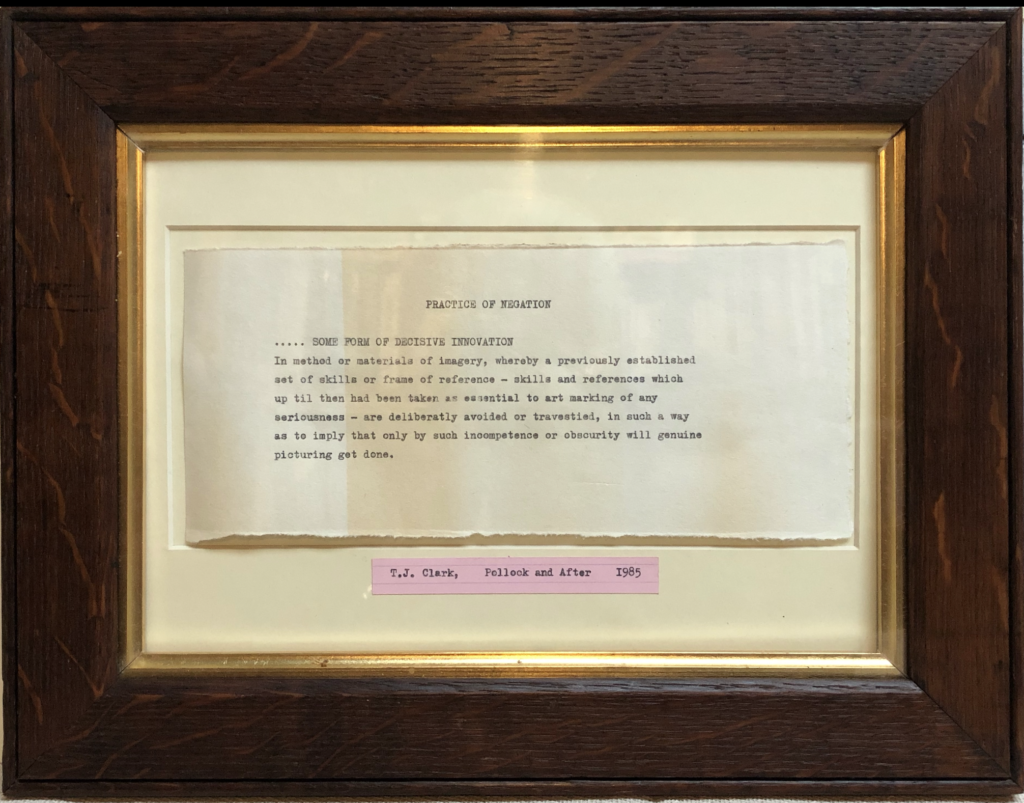
The Frame is Everything explores the relationship between objects, images, ideas and the circumstances through which they acquire meaning.
Each work is housed in an original late nineteenth- or early twentieth-century oak frame. Seen together, these deliberately old-fashioned frames become something other than decoration. They take the work back towards the beginnings of the modernist project, retrieving an object that Modernism progressively reduced, neutralised and eventually attempted to make disappear. But the return cannot be innocent. Modernism has happened; Conceptual Art has happened. The frame comes back carrying that history with it.
Within them, quotations, photographs, documents, drawings, memories and fragments of other things are removed from one context and placed within another. Their status is consequently unstable: document can become image, anecdote can become history, discarded material can become relic, and an apparently insignificant object can acquire the authority of an artwork.
The physical frame therefore becomes part of a larger proposition. Meaning does not reside securely within an image, text or object but is produced by the historical, political, institutional and intellectual frames through which it is encountered.
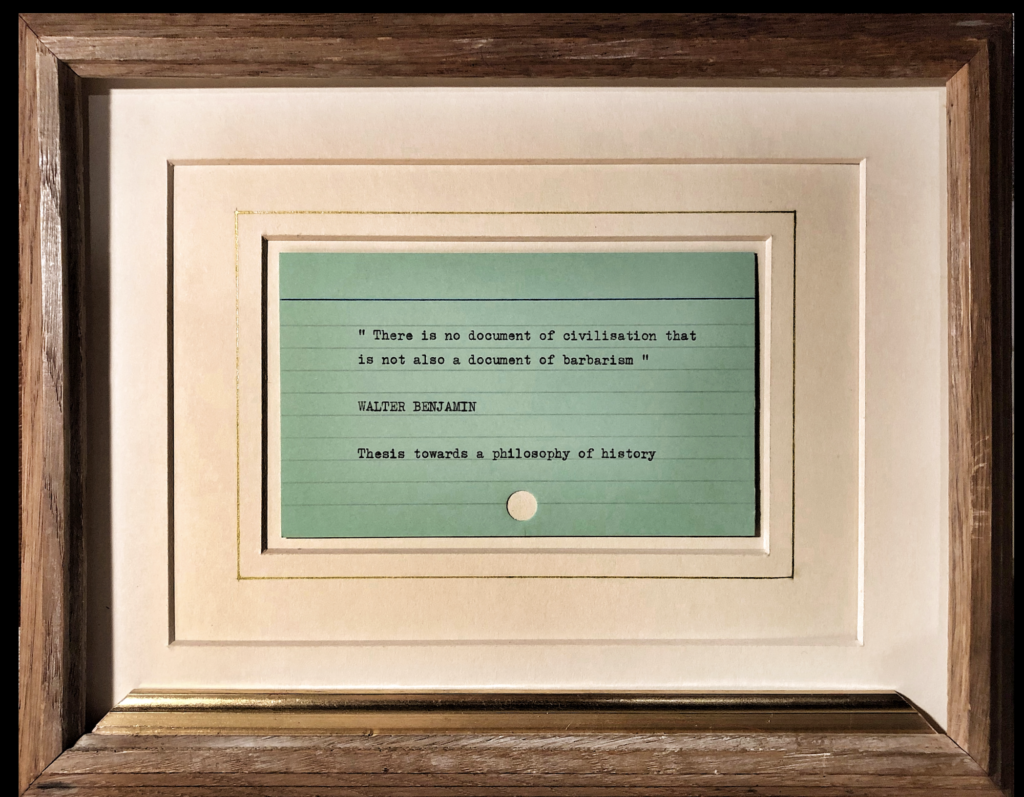
Walter Benjamin has remained a constant presence in my work since leaving art school. His observation that “There is no document of civilisation which is not at the same time a document of barbarism” continues to inform my understanding of history, archives and representation. T. J. Clark’s writing on the practice of negation offered another way of thinking about artistic practice: not as affirmation, but as a critical activity conducted from within the forms and histories it inherits.
The methods used to make the works extend this idea of displacement. Text is typed on a mid-century Olivetti typewriter; photographic and drawn images are printed in reverse onto waxed paper and transferred while the ink remains wet. The resulting image is not drawn or painted directly onto its final support. It has travelled there from somewhere else.
The same is true of much of the material contained within the frames.
Nothing arrives innocent.
The frame is everything.
The Aura
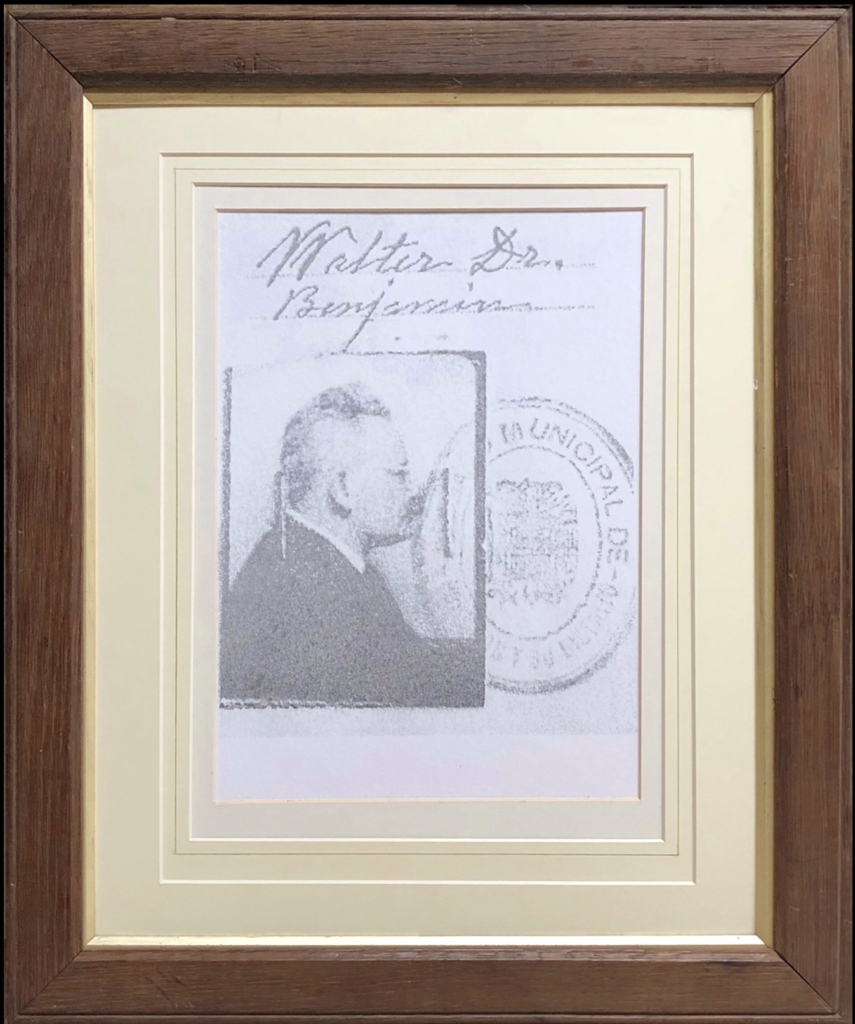
Benjamin’s passport photograph occupies a particular place within the series. It alludes to his final journey towards the Spanish border in 1940, his inability to complete that crossing, and the library and intellectual world he was forced to leave behind. The image is less a portrait than a fragment of historical evidence, asking how a single document can come to embody the loss of an entire life of thought.
Girl with an Apple (9 mins 29 secs)
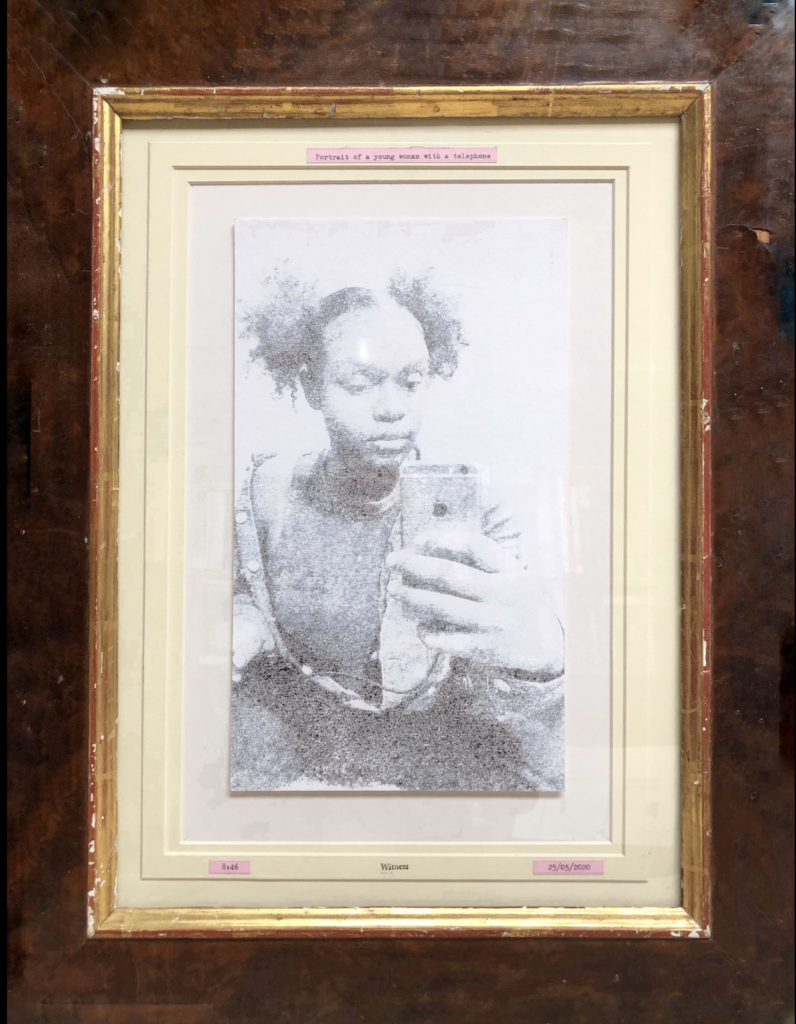
This wax-ink monotype depicts Darnella Frazier, whose mobile phone recorded the murder of George Floyd on 25 May 2020. Lasting 9 minutes and 29 seconds, her recording became one of the defining documents of the twenty-first century, bringing global attention to police violence and giving renewed force and unprecedented international visibility to the Black Lives Matter movement.
Like the earlier works in The Frame is Everything, the image is produced without drawing. A laser print is made in reverse onto waxed paper and, while the ink remains wet, transferred directly onto the final support. The image is never touched by the artist’s hand. It arrives as a trace, carrying the authority of a document rather than the interpretation of a drawing.
The work asks how an ordinary act of witnessing can become an historical document. In this case, a mobile phone performs the function once occupied by the camera, the archive and the written record. The witness becomes the author of history.
Noel Engle (Scott Walker): Mute
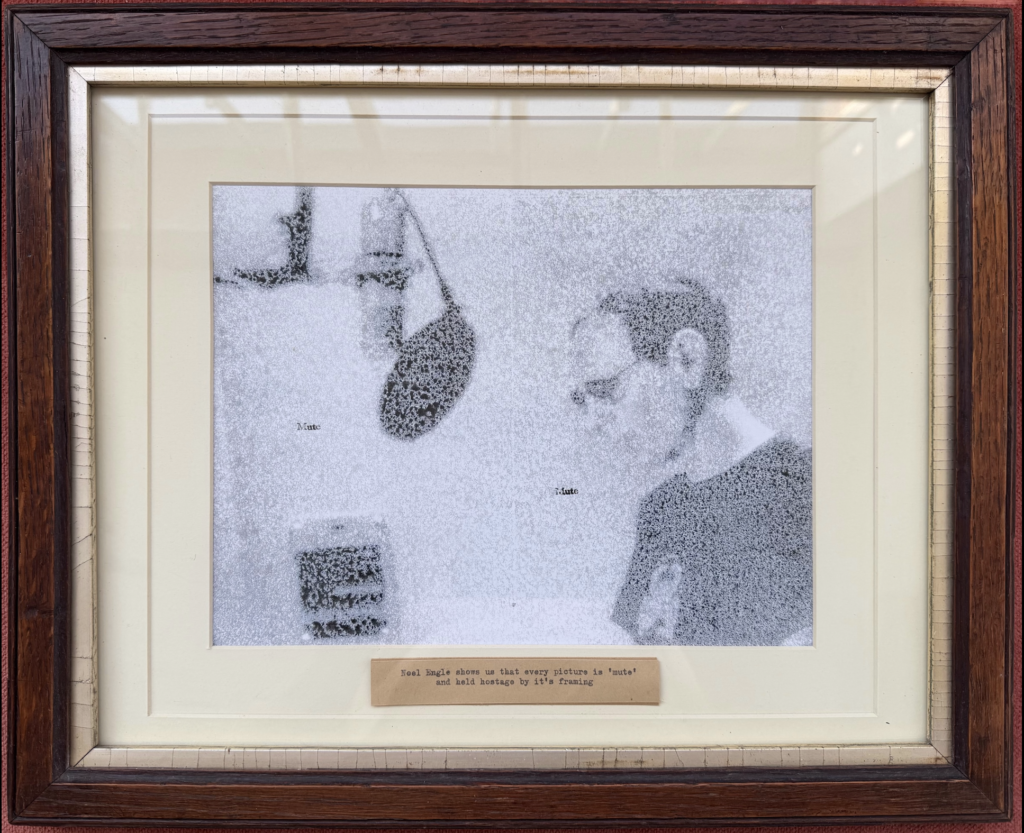
Part of the series The Frame is Everything, Mute explores the limits of representation through both its subject and its material construction.
The work depicts Noel Engle—better known as Scott Walker—standing before a microphone. Possessing one of the most distinctive voices of his generation, Walker is represented through a medium incapable of transmitting the very quality for which he is known. The microphone promises sound, yet the image remains irrevocably silent.
Rather than using a straightforward photographic print, the image is produced through an ink and wax transfer process. This act of mediation is critical to the work. Information is inevitably lost during the transfer; tonal values fragment, edges dissolve and the image becomes increasingly unstable. The process makes visible the distance between an event and its representation. Every act of translation alters what it seeks to preserve.
The repeated word Mute appears within the image, acknowledging not only the silence of the subject but also the silence of the medium itself. The accompanying text states:
“Noel Engle shows us that every picture is ‘mute’ and held hostage by its framing.”
Here, framing operates on several levels. The physical frame encloses the work, but framing also describes the conditions through which meaning is constructed. The transfer process, the cropping of the image and the material limits of representation all determine what remains visible and what is irretrievably lost.
Seen within the broader context of Wagg’s practice, Mute introduces concerns that recur throughout later projects. Historical documents, surveillance images, paintings and archives are never treated as transparent records but as mediated objects whose meaning is shaped by processes of translation, framing and loss. The work suggests that representation is never complete; every image carries with it both what survives and what disappears in the act of mediation.
The title and accompanying statement also acknowledge Art & Language’s Hostage in the Museum paintings. If those works propose that paintings are held hostage by the institutional and ideological conditions in which they are encountered, Mute shifts the question towards representation itself. Here, the image is held hostage by its framing—not only by the physical frame surrounding it, but by the medium through which it is translated and by the inevitable losses that accompany every act of mediation.
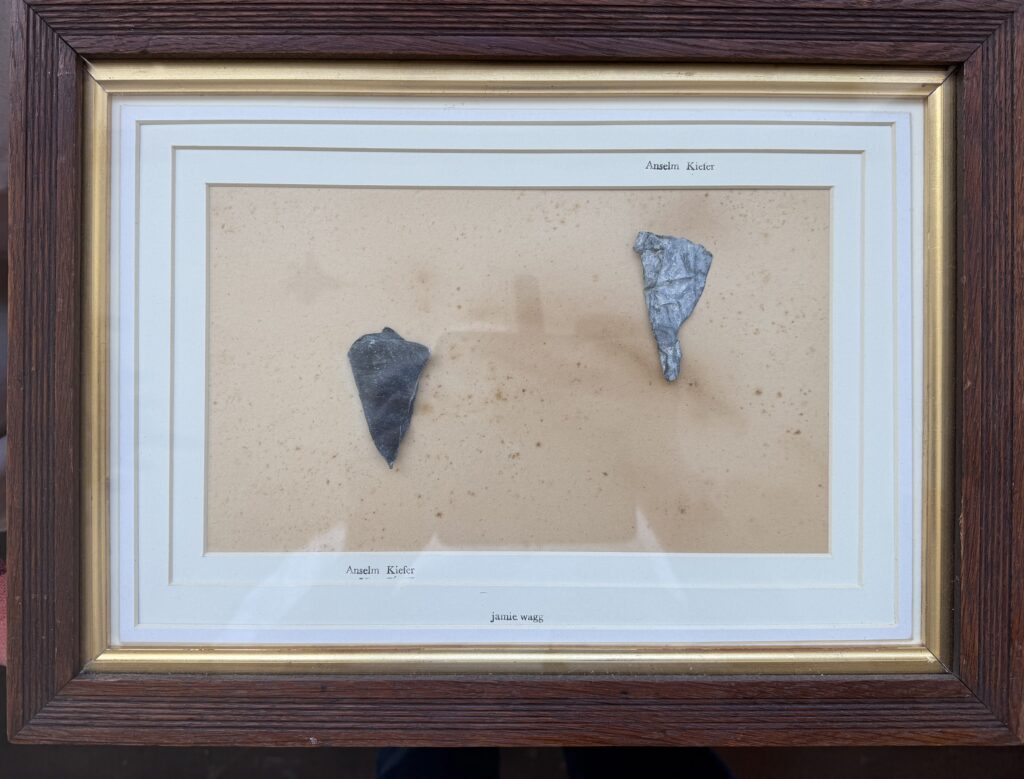
Two pieces of Anselm Kiefer.
A small piece of the High Priestess joins a small piece of The Women of the Revolution, one from The Riverside Studios, 1989, the other from the Anthony D’Offey gallery, 1992.
This lead contains the weight, majesty of bombast of Anselm Kiefer’s ‘history work’….. or not, who knows.
The stolen sunflower seeds were lost so the lead must carry the weight of the work.
Nothing arrives innocent
Lead, mount, letterpress type, glass and antique frame.
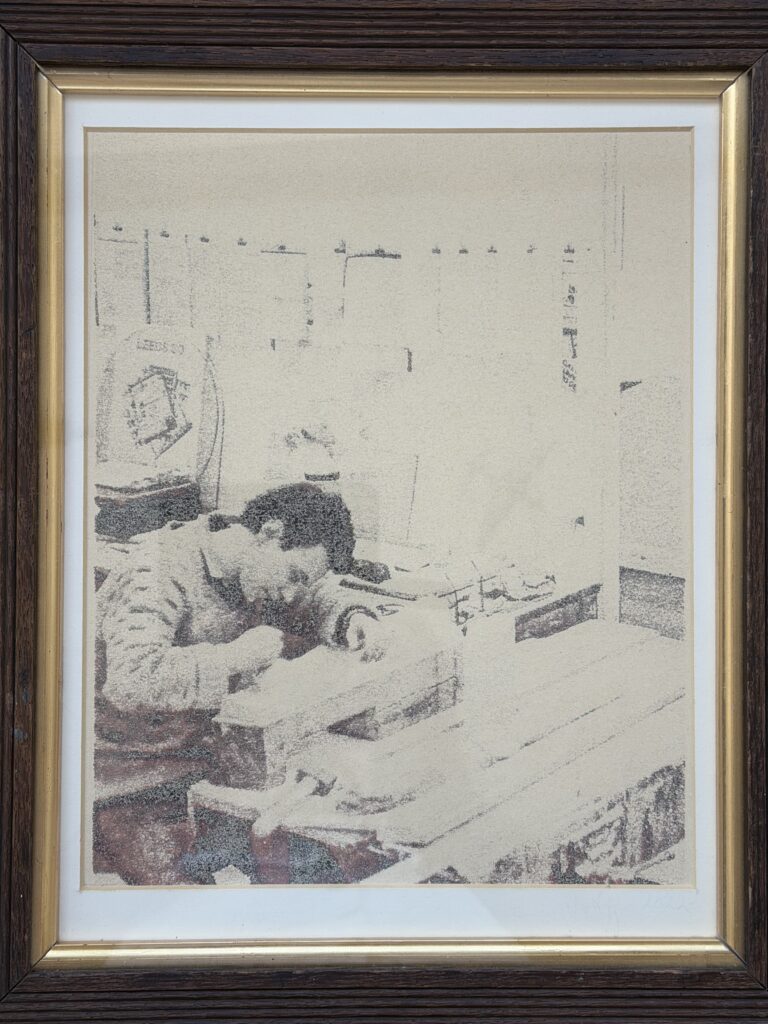
“A Trans-Historical skirmish in the Theory / Practice wars fought in Leeds in the late I970’s ……….. Structuralism / Post Structuralism
With his texts on the wall, Toddy Kirkham carves a marble arm with which to defend his practice.”
ink & wax drawing on lining paper 2022
In the late 1970s the arguments around Theory and Practice at Leeds Polytechnic were constant. Toddy Kirkham, a fellow student, submitted a thesis on Structuralism and Post-Structuralism which was failed by the Polytechnic’s General Studies department. Our tutor, Geoff Teasdale, sent it to the Philosophy Department at the University of Leeds to be re-marked. It was subsequently awarded a First — and, I was told, the highest mark the department had ever given.
More than forty years later I reconstructed the episode as a small history painting. With his theoretical texts pinned to the wall behind him, Toddy continues to carve a marble arm with which to defend his practice.
The argument between Theory and Practice is resolved by neither.
The theory is on the wall; the practice is on the bench; the drawing requires both.
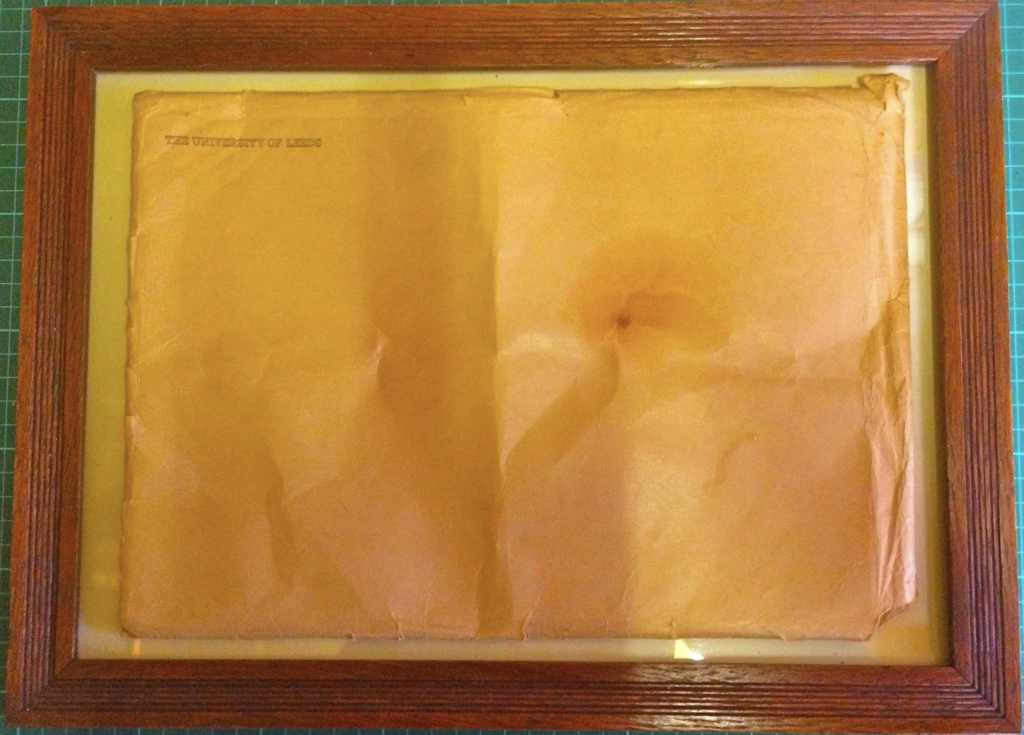
This envelope contains all my academic qualifications: ten O levels, five A levels, a 2:1 Fine Art degree and a Master’s with distinction. The certificates remain inside it.
For years, when students at Byam Shaw became anxious about their final degree classifications, I would tell them that throughout my subsequent life as an artist — exhibitions, teaching, lectures and invitations — nobody had ever said: “Before we go any further, what grade did you get?”
The envelope, meanwhile, continued doing exactly what it was designed to do. It kept the certificates safe.
After all these years, the envelope has proved more useful than the qualifications it contains.
So I framed it.