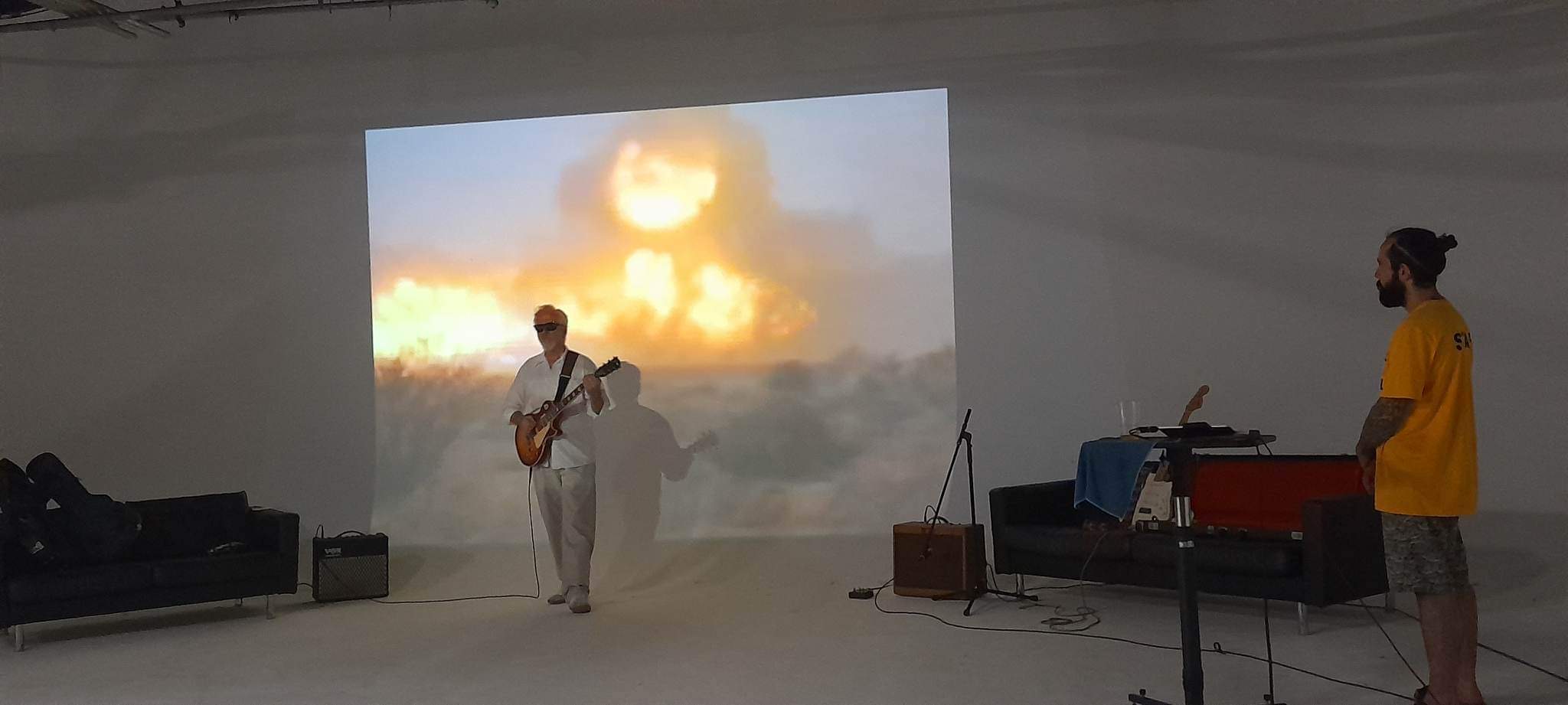
Entangle(ment) Histories: From Einstein’s Pollen to Flower Power.
Some Ideas……..with guitars
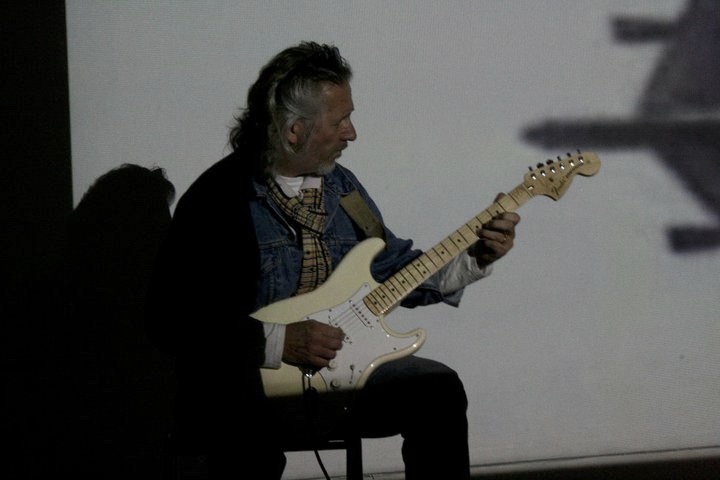
Archive note
The earliest surviving documentation of the project. First presented in the lecture theatre of The Byam Shaw School of Art, London, in 2005 under the working title Some Ideas (with Guitars)—a reference to the opening line of The Clash’s Know Your Rights*: “This is a public service announcement… with guitars.”*
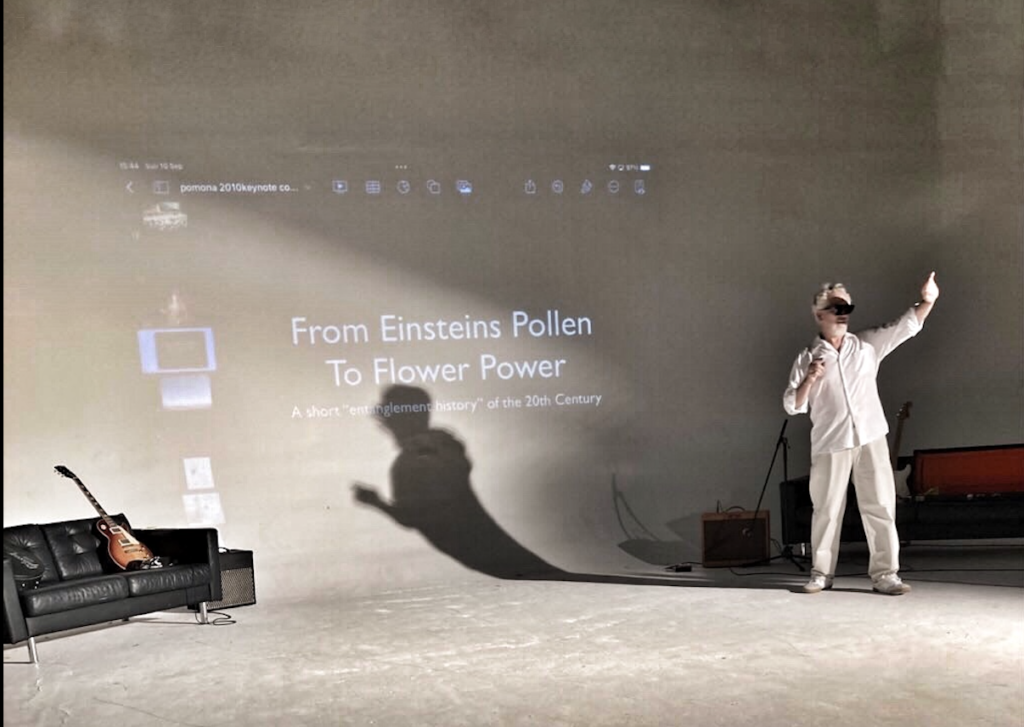
Entangle(ment) Histories: From Einstein’s Pollen to Flower Power, is a performance lecture that traces an alternative history of the twentieth century through unexpected connections between science, technology, music, politics and culture.
Rather than presenting history as a sequence of discrete events, the project explores how ideas become entangled across disciplines, generations and historical periods. It asks whether history is better understood not as a linear chronology but as a dynamic network of relationships in which concepts, inventions and cultural forms continually intersect, reappear and acquire new meanings.
Beginning with the ancient dispute between Democritus, who proposed that the universe was composed of atoms, and Aristotle, whose natural philosophy dominated Western thought for nearly two millennia, the performance asks how our understanding of knowledge and history might have developed had atomism prevailed. Rather than viewing history as a catalogue of isolated happenings, Entangle(ment) Histories speculates whether ideas themselves can be understood as remaining connected across time, in ways analogous to the notion of quantum entanglement. From this perspective, coincidence becomes less important than the hidden relationships that bind apparently unrelated events together.
Beginning with Albert Einstein, developments in electromagnetism and quantum theory, the performance follows an unexpected chain of historical relationships extending through technological innovation, popular music and political change. Objects as diverse as the bass drum pedal, amplified sound, nuclear destruction and the solid-body electric guitar are treated not simply as historical artefacts, but as active participants within wider historical transformations. Scientific discoveries, technological inventions and cultural movements are presented as mutually dependent rather than existing within separate historical narratives.
Combining lecture, performance, projected image and sound, Entangle(ment) Histories proposes an alternative model of historical understanding. Rather than treating history as a chronological archive of completed events, it suggests that ideas migrate, intersect and re-emerge across time in unpredictable ways. The work invites its audience to consider history as an evolving field of relationships in which science, technology, politics and culture continually reshape one another.
Ultimately, Entangle(ment) Histories asks whether history should be understood less as a chronology of isolated events than as an interconnected ecology of ideas, where the significance of any single moment lies not only in its immediate context but also in the unforeseen connections it establishes across time.
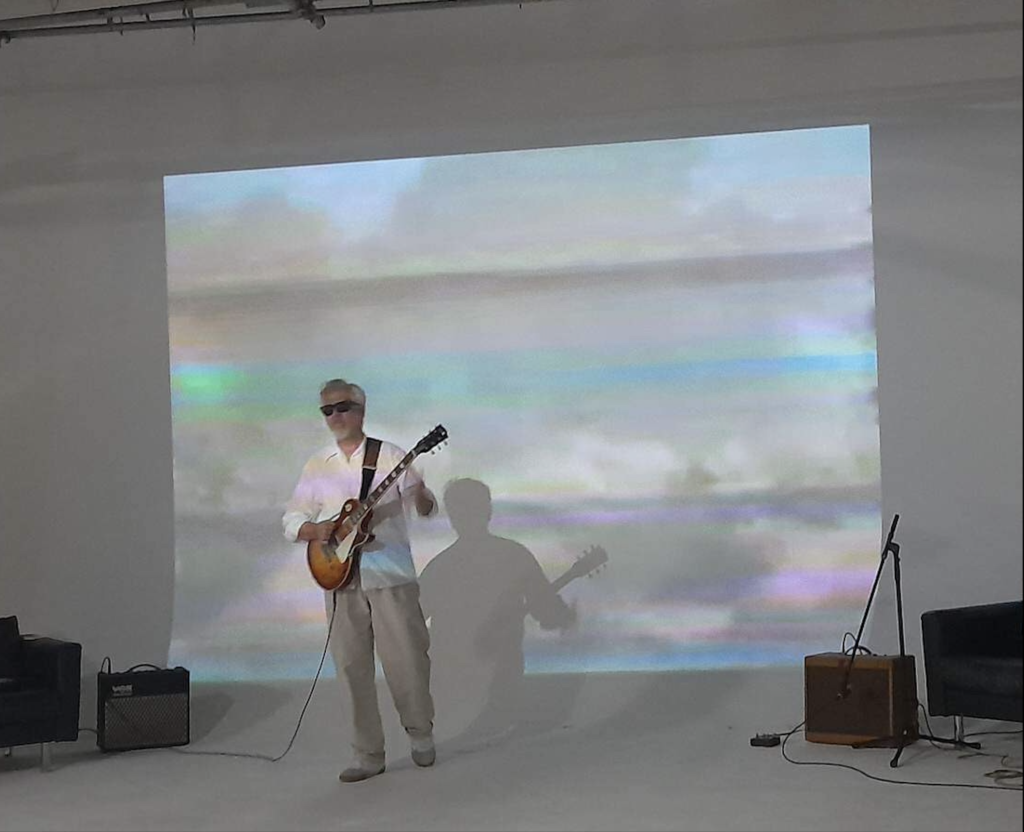
The performance argues that technological inventions are never politically neutral. The same scientific discoveries that make possible nuclear weapons also make possible the electric guitar; history emerges not from isolated inventions but from the unpredictable ways technologies are appropriated within culture.
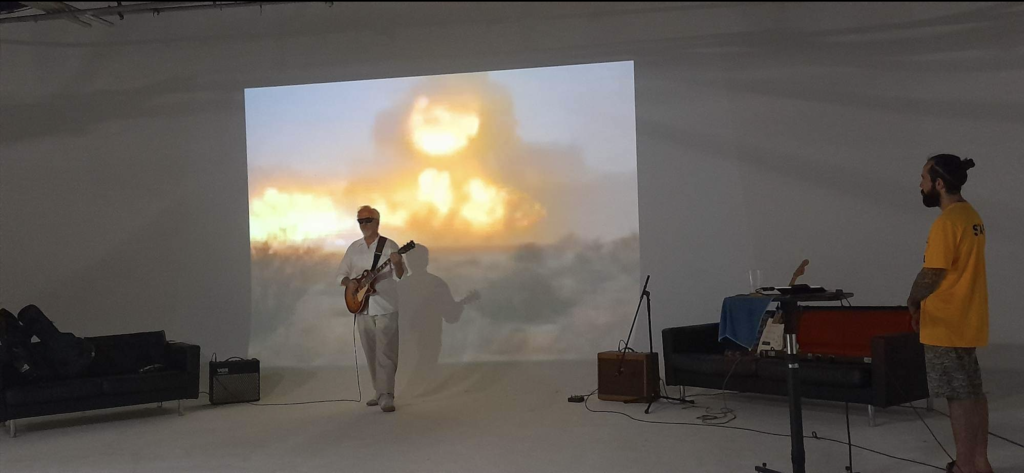
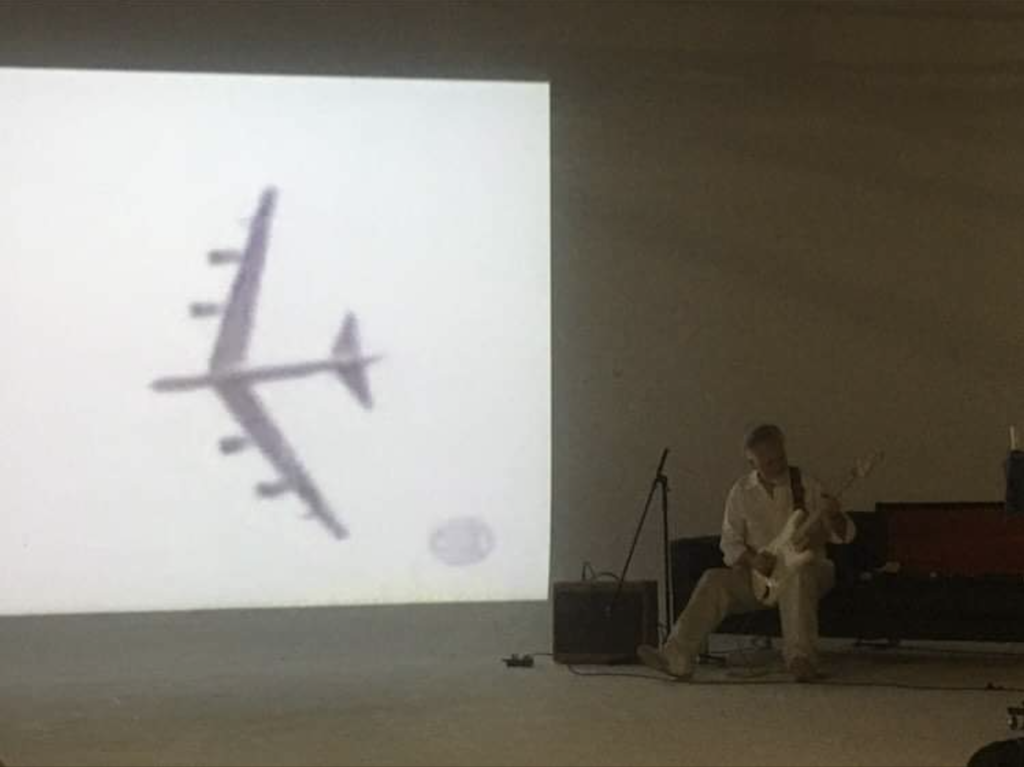
The subtitle From Einstein’s Pollen to Flower Power describes the conceptual trajectory of the performance. It begins with Democritus’ ancient theory of atomism and Einstein’s explanation of Brownian motion—the seemingly random movement of pollen suspended in water—which provided compelling evidence for the existence of atoms. From there, the lecture traces the consequences of scientific discovery through electromagnetism, technological innovation and amplified sound, culminating in Jimi Hendrix’s performance of The Star-Spangled Banner at Woodstock in 1969, where the electric guitar became not merely a musical instrument but the management of an electromagnetic signal and a medium for political expression.