Historical Engineering
Closed-circuit CCTV installation
First shown at Norwich School of Art 1997
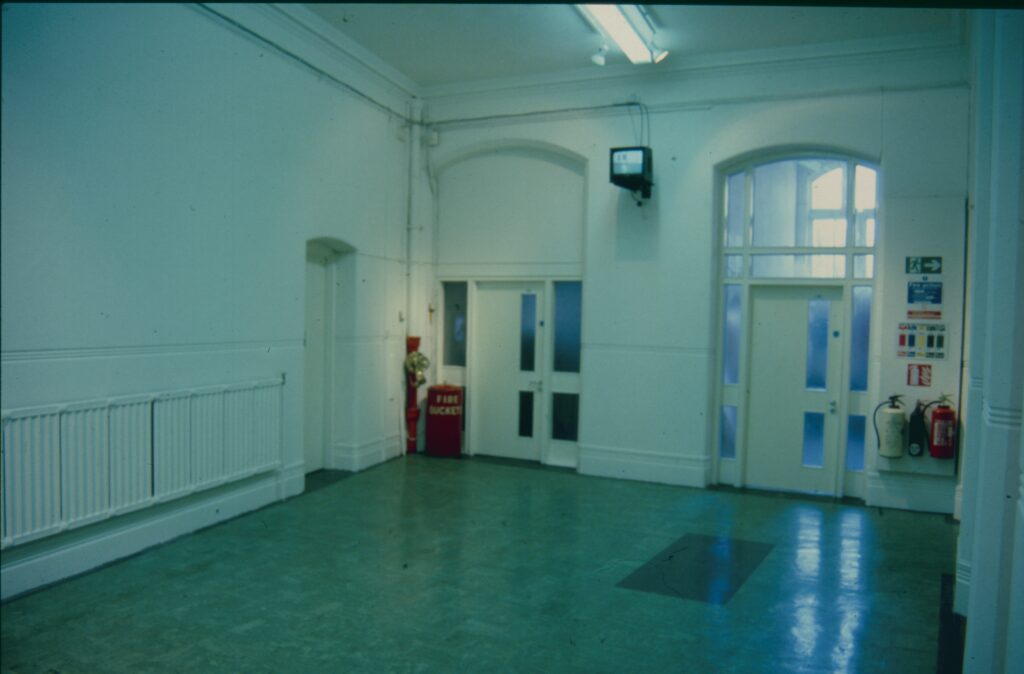
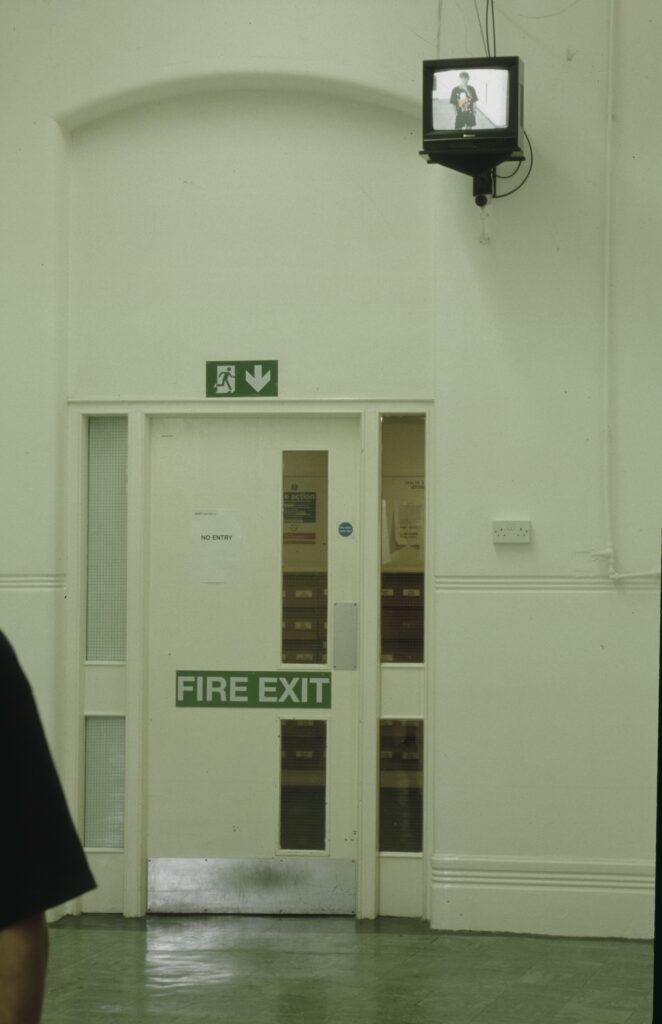
Two CCTV cameras are wired to opposing monitors. Looking at one screen, the viewer sees only the back of their own head. Their enquiring face is simultaneously displayed on the monitor behind them, remaining permanently out of sight. The installation creates a simple paradox: we can never fully occupy the position from which we are observed. Borrowing its title from Noam Chomsky, Historical Engineering extends this question from perception to history itself, asking who sees, who is seen, and how every point of view is constructed.
Historical Engineering
At first encounter, Historical Engineering appears to belong to the tradition of closed-circuit video installations developed during the 1970s and 1980s. Two CCTV cameras are wired to opposing monitors so that the viewer, standing before either screen, encounters only the back of their own head. Simultaneously, the image of their enquiring face appears on the monitor behind them, permanently beyond their field of vision. The work establishes a simple but disorientating condition: the moment one attempts to observe oneself, one’s own act of observation becomes inaccessible.
The installation is less concerned with surveillance than with the impossibility of occupying two positions at once. The observer and the observed are separated by the very system that appears to unite them. One can either look or be looked at, but never experience both simultaneously. The work transforms closed-circuit technology into a philosophical proposition about perception itself: every act of seeing necessarily excludes another point of view.
Its title, borrowed from Noam Chomsky, extends this proposition beyond individual perception towards history and politics. If vision is always conditioned by position, then historical understanding must be similarly constructed. History is not simply discovered but organised through systems that determine what becomes visible and what remains hidden. Every historical account carries with it a blind spot, not because of individual failure, but because perspective itself is structured by absence.
Seen in retrospect, Historical Engineering occupies a significant place within Jamie Wagg’s wider practice. Although realised through video rather than painting, the work introduces concerns that continue to develop over the following decades. Throughout later projects—including Documents as Monuments, Entangle(ment) Histories and From Guernica to Gaza—documents, paintings, archival material, political events and historical narratives are repeatedly placed into new relationships. Meaning is never located within a single image or object but emerges through the system of connections established between them.
The installation therefore anticipates a broader methodology. Rather than treating artworks as isolated statements, Wagg increasingly constructs frameworks within which viewers negotiate multiple viewpoints simultaneously. The historical document, the painted image, the performance, the archive and the exhibition itself become interconnected elements within larger structures of meaning. Individual works operate less as conclusions than as nodes within an expanding network.
This emphasis on relationships distinguishes Historical Engineering from many earlier investigations of video feedback. Closed-circuit technology is not employed simply to explore self-consciousness or the mechanics of surveillance. Instead, it becomes a model for understanding how knowledge itself is produced. The viewer discovers that complete self-knowledge is impossible because one can never occupy every position within the system at once. Likewise, historical understanding can never claim complete neutrality, since every account is shaped by the perspective from which it is constructed.
Viewed today, Historical Engineering can be understood as an early articulation of a question that has remained central throughout Wagg’s practice: how are relationships engineered, and how do those relationships determine what history allows us to see? The work suggests that the most important structures are often those that remain invisible—the systems that organise perception before perception itself begins.