Cultural Object:
John Barnes, Mechanical Reproduction and the Individual
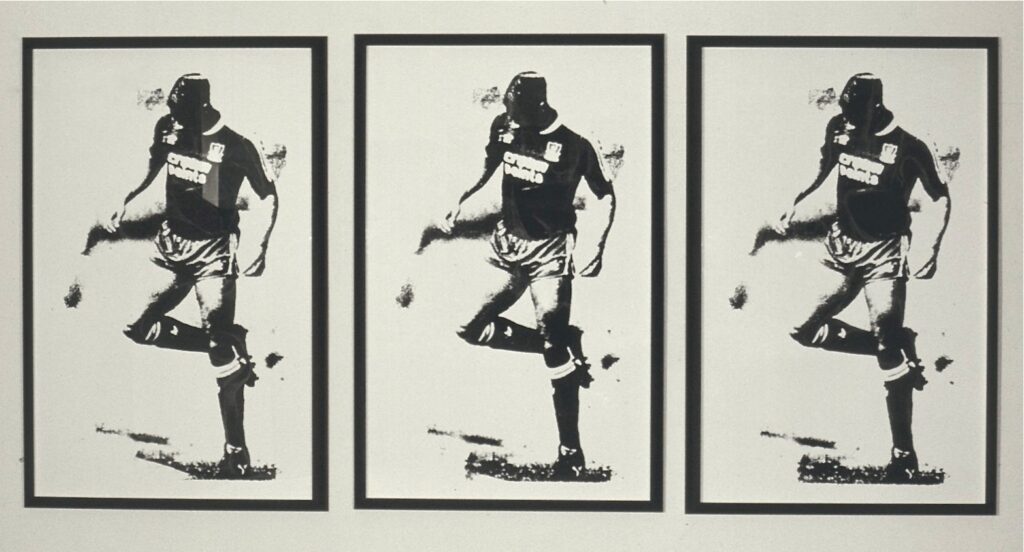
Made in 1988–89, Triptych and Cultural Object occupy an important position within Jamie Wagg’s early practice. Although rooted in a specific historical event—the racist abuse directed at Liverpool footballer John Barnes during his first Merseyside derby at Goodison Park—the works are not simply about football, nor are they straightforward condemnations of racism. Instead, they explore the intersection of history, mechanical reproduction, colonialism and the status of the individual within systems of economic exchange.
Barnes, born in Jamaica and of African heritage, arrived at Liverpool Football Club at a moment when he had already become one of the most recognisable Black athletes in Britain. During his first appearance against Everton, play was repeatedly interrupted as bananas were thrown onto the pitch by sections of the crowd. Set against Liverpool’s historical wealth as one of the principal ports of the Atlantic slave trade—and home to Britain’s oldest Black community—the incident exposes a profound historical contradiction. Barnes becomes more than an individual footballer; he functions as a metaphor through which the legacies of empire, slavery and racial prejudice continue to manifest themselves within contemporary culture.
The triptych consists of three silkscreen prints that initially appear identical. Their apparent uniformity, however, is deliberately undermined by the printing process itself. By heavily overloading the screen with ink and refusing the precision of a vacuum bed, each impression accumulates its own unique surface of smears, deposits and accidental marks. What appears to be mechanical repetition is revealed, upon closer inspection, to be a sequence of singular objects.
This technical decision forms the conceptual centre of the work. It recalls Walter Benjamin’s writings on mechanical reproduction, yet simultaneously complicates them. Benjamin famously argued that technological reproduction erodes the singularity—or “aura”—of the artwork. Wagg’s triptych proposes a different possibility: that the supposedly identical reproduced image is never truly identical. Every impression insists upon its own material individuality.
The implications extend beyond aesthetics. If the Atlantic slave trade sought to reduce human beings to interchangeable units of labour and exchange, Triptych quietly resists this logic. Beneath the appearance of uniformity, every print remains irreducibly distinct. The printing process itself becomes an ethical argument, transforming mechanical reproduction into a meditation on individuality and historical memory.
The companion work, Cultural Object (subtitled John Barnes Clearing Bananas from the Field of Play), shifts this enquiry into the language of painting. The subtitle anchors the work in a specific historical event, while the painting itself refuses simple reportage. Barnes emerges only partially from a richly worked surface of gold leaf and gesso, oscillating between portrait, icon and historical trace. The image no longer functions merely as a depiction of a footballer but as a meditation on the afterlife of an event within cultural memory.
Viewed today, these works reveal themselves not as isolated investigations but as the beginning of a sustained intellectual trajectory. The concerns that later define Wagg’s practice—archives, documents, historical images and the politics of representation—are already present. Triptych and Cultural Object are less concerned with depicting an event than with examining how history itself is constructed, circulated and remembered through images.
Rather than treating the John Barnes incident as an isolated act of racism, these works situate it within a much longer history of empire, capitalism and representation. In doing so, they anticipate the later Documents as Monuments series, where archival texts and images cease to function as illustrations and instead become the very material through which history is interrogated.
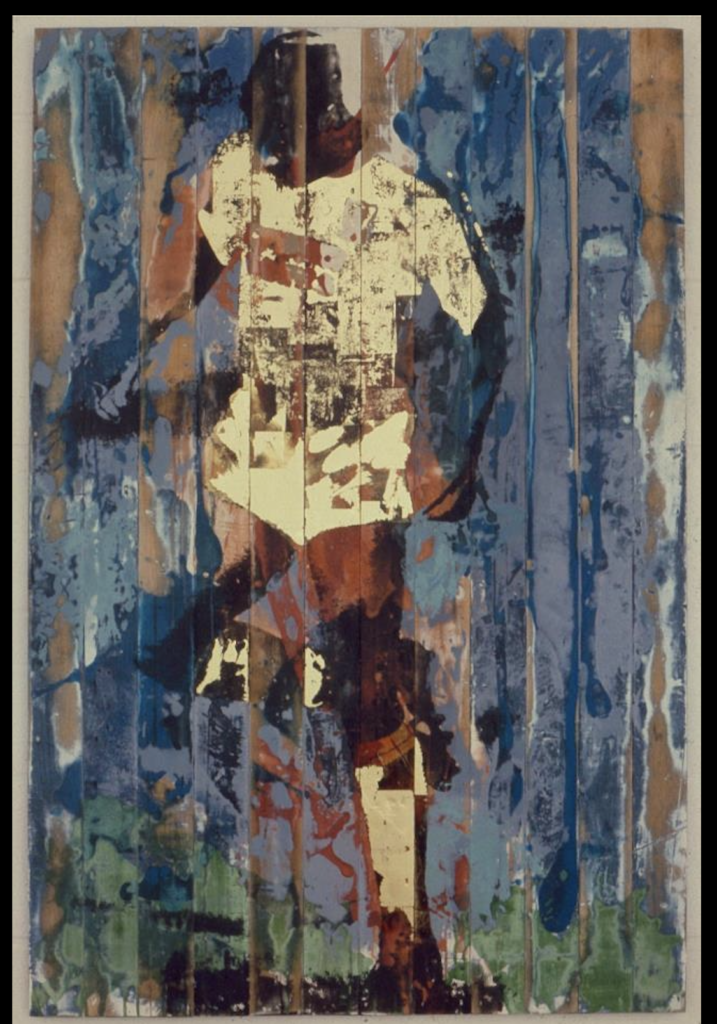
Cultural Object
John Barnes Clearing Bananas from the Field of Play
Gold leaf, pigment and gesso on wood pane.
1988-89